Friday, June 30, 2017

5 Books That Made Me a Writer


When I want to learn how to do something, I reach for a book.  This approach did not serve me well when I decided I wanted to learn to knit.  It took one-on-one lessons from my sister for me to perfect a knitting style that many people would call ‘eccentric’.  Books have helped me become a writer, though. The act of reading widely from a very young age has given me some of the skills I need, but there are a few books that have influenced my habits as well.
Natalie Goldberg’s Writing Down the Bones:Freeing the Writer Within is the first book on writing that I fell for hard and the one that had the most lasting impact on my writing process. Her perspective is that of a Zen Buddhist with a serious practice, but her approach to writing is playful as well. Goldberg is all about making writing a discipline. Her view is that if we sit down and write consistently, we will be writers.  And that is how I feel; I call myself a writer when I am writing every day.  When I am not, I don’t. Maybe at those times I am a writer on hiatus? In remission? When I first read the book about 26 years ago, I filled spiral notebooks with daily writing on everything from wild ideas for novels to how the Kansas hayfields I drove by every evening reminded me of Monet.
Goldberg’s rules for writing practice are the most helpful ones I’ve found for the act of writing a draft, useful enough that I share them with my students when I ask them to write an oratory. In Bones, she lists and explains them:

1. Keep your hand moving. [Don’t pause to reread the line you have just written. That’s stalling and trying to get control of what you’re saying]

2. Don’t cross out. [That is editing as you write. Even if you write something you didn’t mean to write, leave it.)

3.  Don’t worry about spelling, punctuation, grammar. [Don’t even are about staying within the margins and lines on the page]

4. Lose control.

5. Don’t think. Don’t get logical.

6. Go for the jugular [If something comes up in your writing that is scary or naked, dive right into it. It probably has lots of energy.]


A blank page is terrifying. Heeding Goldberg’s tutelage, I try to get a lot of stuff down on the page so the fear goes away.
     Anne Lamott’s Bird by Bird is full of advice for nervous writers. She advises writers to allow ourselves to write badly in order to write well. Her term for what we churn out when we first being writing a piece is "shitty first drafts". Her advice has heft for me, as a writer and as a teacher. In my own work, I can appreciate that the first words on the page are not going to be the best and I’m better able to face revisions. As a teacher, I see that students have to be willing to be bad at something before they can be good. Band students understand this because they’ve been the sweaty middle school clarinet player whose horn made odd hoots that sounded like their classmates' changing voices. Lamott, who has made a career out of writing about her worst qualities in the best way, is a writer who helps us give ourselves permission to be bad, very bad, so we can get better.
I have been reading Stephen King’s fiction for almost forty years. His reflection on craft, On Writing, gave me new appreciation for his work as well as confirmation that reading is never a waste of time for a writer. Long ago, in an introduction to Harlan Ellison’s Stalking the Nightmare, King wrote about how writers are like milk at times, and they take on the flavor of what’s beside them in the refrigerator.  For writers to find their own voice there has to be a lot of stuff in the refrigerator.  King’s book is more about craft than it is about motivation, and part of honing craft for a writer is reading other writers.
Rosemary Daniell’s The Woman Who Spilled Words All Over Herself has a special place on my shelf, too.  Again, this book had a binary influence on me, as I read it both as a teacher and a writer.  Much of the book concerns her work as a Poet in Residence in schools throughout Georgia, her experience as a writing teacher in prisons, as well as stories of her own writing experience.  This book lit up the part of my brain that is always at a slow percolation, thinking, “How can I teach…” while it also inspired me to write more myself.  One drawback to Daniell’s books is that I feel that a lot of her energy comes from the deep work she’s done on her relationships with her family and the men in her life, and my life just isn’t that dramatic.
Another writer whose genre fiction I have enjoyed is Rita Mae Brown. The mysteries she ‘co-wrote’ with her cat Sneaky Pie are my favorite kind of fiction because they are both entertaining and informative. Brown’s book on writing, Starting From Scratch: A Different Kind of Writer’s Manual, outlines her concept of a conservatory for writers and includes a list of books she thinks every writer should read. Her list is largely classical, but spans genres and would make a good liberal education for anyone, not just a writer.
I have to warn you, though, that READING about writing isn’t writing. It might be tempting to live vicariously through these other writers’ experiences instead of sitting down and writing something yourself.  If you read all of these books and still don't put butt on chair, pen to paper, or fingers to keys, then reading any of them hasn't really mattered at all.

Wednesday, June 28, 2017

Should It Stay or Should It Go? Get in That Pickup and Drive!


Aside from two fully employed adults, our home houses several thousand books.  Because we don’t practice the “one in, one out” philosophy in acquiring them, the books overfill the shelves and are stacked on flat surfaces around our home. Yet, I often can’t resist picking up another book I haven’t read from the 25 cent table at my favorite book store or a pile at a library sale. Thus this series, “Off My Shelf,” where I take a book from a shelf or a pile, read (or reread it) and decide whether it stays or goes.

It’s irritating to open a book on a weekend afternoon expecting a light, romantic escape to find instead a dour literary novel with a disconcerting habit of bouncing around from one point of view and verb tense to another.
Such a novel is Girls in Trucks by Katie Crouch.
From the description of Sarah, the main character, as "one of the funniest and most sympathetic literary heroines in years" and Crouch's wry opening description of Sarah’s Cotillion experience, I thought I was going to read a light novel about a plucky Southern girl who gets the wind knocked out of her up North and goes home to recover. Maybe there would be some romance? Indeed, the blurbs on the book jacket promised a charming book from a writer who was “damn funny”.
I feel punk’d.
Crouch does a fine job in the early chapters as Sarah suffers the indignities of the Cotillion, the training ground where Charleston girls become Charleston women.  She deftly contrasts the two sisters, Sarah and Eloise, who struggle to escape ‘yokel land’.
However, the tone changes about a quarter of the way through the book, the point of view turns from first person to third and the tense from past to present for a chapter. When the author returns to first person past tense, Sarah gets involved in a relationship that leaves her both psychically and physically battered and the whole book takes a shrieking turn into territory I was not ready to travel.
As the novel progresses, the author switches among not only different points of view but point of view characters as well to tell what is primarily Sarah's story. This tactic does illuminate some of Sarah's experience, but at the end of the novel I am still puzzled as to why Sarah made the choices she did and I end up not caring that much about her at all.
If I don't engage with the character, if I don't enjoy the story, if none of the words are notable enough to add to my commonplace book---it's three strikes and this one is out.


Monday, June 26, 2017

Quotations and My Discontents


     A stock photo of a curling piece of notebook paper. Just a corner, torn from a larger sheet.  A note, written in the fat, looping letters of a “tween”-age girl. On the paper, the following quotation: 

     “You don’t love someone for their looks, or their clothes, or for their fancy car, but because they sing a song only you can hear. ---Oscar Wilde.”
     
     Oscar Wilde?     
     Along with postcards, cookbooks, Crayola themed tchotchkes, and journals, I hoard quotations. Long ago, when memes were “Xerox Lore” and my Pinterest board was an actual corkboard behind my desk, I started.  Now, the Internet has become a crowded bazaar of quotations of all kinds, and I’m glad because I am a fan of a well-turned phrase, but I am also a fan of proper citation. One of the things I appreciate about a good quotation is how the tone of matches the tone of the author. Many times I’ll find a quotation I like, but the attribution is wrong. It’s almost as though Oscar Wilde was responsible for every British ‘bon mot’ and either Mark Twain or Abraham Lincoln in charge of the American equivalent.
     Here are five of the most meaningful quotations I find myself returning over and over. Each of them represent the voice of the author, even though even I am guilty of crediting the wrong person occasionally.


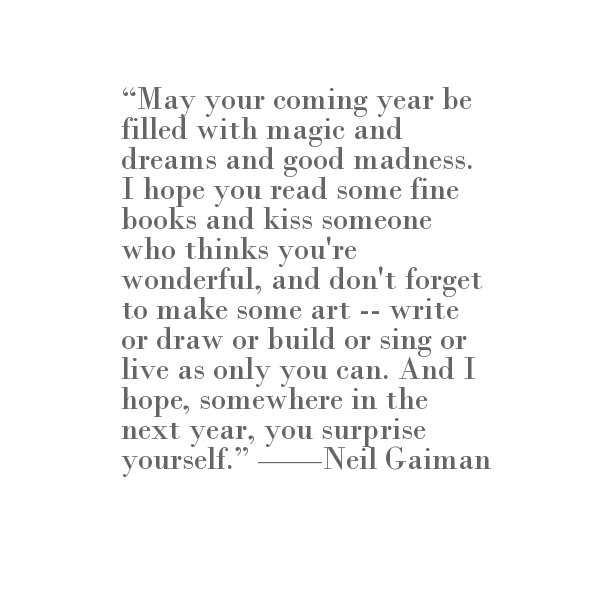
     I’ve pasted Gaiman’s quotation into my journal at the beginning of each new annum for three years running now. Every time I flip by it, the words remind me to make time for the things that matter.


    I’ve tried keeping a gratitude journal and it just doesn’t work for me. What does work is stopping to marvel at some of the random moments that make me happy: seeing the bunnies that have taken up residence in our yard, hearing my favorite Van Morrison song pop up on my iPod mix, smelling the vanilla as it heats up in the pudding I stir on the stove. Vonnegut's words remind us to find small joys and savor them.


     The oldest exhibit in my little museum.  My sister sent this one to me when I was in high school, competing on the Oklahoma high school forensics circuit and discovering that I loved a captive audience. Roosevelt never stood on the sidelines; this is all about taking risks.


    I misattribute this one to Natalie Goldberg even though I know she was quoting Richard Brautigan when she included it in her book.  This quotation is the most important to me as a teacher.  These words remind me that there are only so many minutes in a school year and that I don’t want to be that teacher Brautigan and Golberg describe. Those minutes matter.


     Another quotation that I go back to for inspiration throughout the school year.  I’m not going to make a kid love learning lines or painting flats black, but I can help them discover that once the lines are learned, being someone else onstage is fun, or that hanging out with other people with paintbrushes in their hands is an okay way to spend an afternoon.  I can’t tell them how competing made me feel, but I can get the bus out at 5:30 in the morning and haul them off to another speech tournament so they can discover it themselves.
     Should I be more forgiving of a foible I indulge in myself? Perhaps. Still, I’ve found Garson O’Toole’s engaging reference, Hemingway Didn’t Say That: The Truth Behind Familiar Quotations, a swell guide to some of the crimes against authorship the World Wide Web hosts.  His website, The QuoteInvestigator,is a useful and detailed resource for checking out suspect quotations. I like to check things there when I read a quotation that doesn’t sound just right.
     In the end, Shakespeare's words apply:


Sunday, April 23, 2017


April is National Poetry Month, and there are lots of ways to celebrate. One of them is to write poetry. But you don’t write? You don’t write poetry?  Let me introduce you to the Bonsai Story Generator.


The Generator is one of my favorite spots on the Internet.  The story of the generator is a simple one.  A group of writers exchanged white elephant gifts during their holiday get-together and one of them used a pencil and strips of paper inscribed with sentences derived from members’ stories to create a “Christmas tree”. In the online version of that tree, users feed text into the generator, click on a button, and receive something new and different.
“Story Generator” is a misnomer.  The process doesn’t produce a story so much as an evocative collection of words. I find the output fertile material for generating all types of writing.  I’ve “bonsai-d” my own writing to produce new iterations of poems or generate text when I was trying to chop through writer’s block. To celebrate this month of poesy, I started with raw prose materials and then pruned the result into a poem. 

     I took the post “What Students Leave”, copied it, pasted the contents into the generator, clicked the “Bonsai this Text” button, and instantly perused the result.  Much of the prose that resulted is the background for the graphic at the top of this post. 
How did I turn all that prose into a poem? I looked for phrases that intrigued me, moved them around, and then filled in stuff until I liked the way it sounded.  Basically, I remembered Tom Robbins’ explanation of how poetry is made: “…by f**king around with syntax”.  I have a pretty casual aesthetic.  I ask myself, “Does this look/sound cool?” and “Does this make me feel something?” So when I thought the poem looked good, sounded cool, and made me feel something, I stopped.
This is the poem that resulted:


Try it out yourself! I’d love to see your results, so post them in the comments to share!


Monday, August 22, 2016

Back to School Stations


The idea of using stations in a high school classroom is a popular one, and with back to school time here or looming for some, it’s gaining traction.  Jennifer Wolfe’s post,No More Lectures: Try Back to School Stations Instead describes using them in her middle school classroom.  I tried them out in my high school speech class, and loved it!
Using stations achieved several things: the process allowed students to move around my room, had students using the interactive whiteboard for once, gave me feedback on students so I could get to know them, and helped us accomplish some minor tasks that would suck up too much time if we did them as a class.
I created five stations: a survey about the class content on the interactive whiteboard, a computer station to complete the Personal Report of Communication Anxiety online, a postcard selection site, a personal survey for students to fill out, and an introduction to our first speech assignment. My room is a good sized one, with a projector and interactive whiteboard, a pod of students computers (3 out of 6 currently working), and 10 rectangular tables arranged into five squares. This is a partial view of my room. A bit of the computer pod is visible off right, under the shelf of trophies.


One motivation for using stations was the idea that students spend a lot of time sitting and listening the first couple of days of school.  I agree that listening is an important skill, but I had promised students on the first day that in our speech class, we spend more time doing stuff than in a typical class.  Setting up stations gave us all a chance to circulate, with a purpose.
The interactive whiteboard in my room is a constant challenge to me.  I appreciate it, but I always feel that students don’t use it enough.  I met the challenge by making the whiteboard one of the station sites.  I set up a survey on Google Forms to solicit students’ opinions about which of the four topics in the class they were most interested in studying.  The survey, which you can find here, is short, and students simply clicked on “Submit Another Response” when they were through and tagged another student to complete the survey. 
     Another station had students complete the Personal Report of Communication Anxiety online.  This is a wonderful tool! The results help me see which students might need extra support or different strategies to speak in front of the class confidently.  I simply added a link from my website to the online version of the instrument and then have students record their results on and index card.  At another station, students filled out another kind of survey, linked here.  Since I ask them to use complete sentences to answer the questions, the responses also serve as short writing samples.
     At the postcard station, I left a pile of postcards from which students chose one they especially liked and addressed it to themselves. I posted instructions about to address a postcard (a skill most freshman don’t seem to possess) and ask them to drop the cards into a basket.  At some point in the semester, I’ll find something positive to share with the student, jot it down on the card, and mail it.  If we do this as a whole class, it takes a lot of time since some students complete it easily and others agonize over the choices.  Making this one station in the rotation made the process flexible enough I didn’t feel guilty about implementing it.  I try to have a variety of cards.  Last year I purchased a set featuring art from Pixar; this year I added some with animals done by different artists.
     Aside from the activity at each station, I learned more about students as they completed the activities.  Who was able to complete the stations on their own? Who needed to be told where to go next, even when the instructions said they didn’t need to do the stations in any order? Who helped their classmates problem-solve? I left each hour knowing more about my students even before I collected the work at each station and reading it.


Friday, July 22, 2016

The Museum is Open: CLMOOC Make Cycle #2


     I did it again.
     I set out to make one thing and ended up with something completely different.
     Object: to explore this week’s theme of “Reciprocate With Gratitude and Generosity” by making something to honor Ray Maxwell and Deanna Mascle for their influence on me during the clmooc. Simple plans to start with: use Google Drawing to create a poster. One page, two people, words and images.
     But why specifically Ray and Deanna? Well, Ray’s introduction, and his confession of the importance of poetry in his life, still sticks with me.  His passion is one example of how important poetry is in a lot of people’s lives.  And Deanna, well, her introduction, too, ringing the changes on the many ways to share who she is, caught my attention. Into the second week, her foundpoem and illustrated tanka were beautiful expressions of the spirit of the clmooc.
     So…poetry.
     Not happy with Google Drawing. Love a museum background from PPT, but it fits badly, and how will I post the finished poster?
     Hmmmm…looking at Sheri’s Found Poetry stuff.  It’s growing.  Google Slides! What if my tip of the hat to Ray and Deanna were a room in a museum?  An interactive museum.  Ray and Deanna are there, their respective pictures framed, but there could also be interactive stuff and links to things to watch or listen to.
     Set up a slide. Import the background. Rough out the design by inserting shapes. Look around the web for content.

     Back at the Found Poetry slides to grab the URL. A little laboratory of collaboration here. What kind of museum has only one room? And shouldn’t there be a front door? Can I do that, just set it up and declare it the “CLMOOC MUSEUM”?  The wisdom from Field of Dreams applies to the mooc: “If you build it, they will come.”

     So now, a museum.  
     A front door, generic in appearance for now, but ready to be spruced up.


Want to design the front door? Go to https://goo.gl/06j484
  
     A room celebrating Ray and Deanna by becoming a window to online poetry of different varieties. 

 Visit https://goo.gl/06j484 to visit the museum or build your room

     And empty rooms, waiting to be filled with artifacts and things of interest, to celebrate and document, to arouse amusement and wonder. 

Wednesday, July 20, 2016

Getting in the Flow


     The last computer class I had was in high school, over 30 years ago. I had already completed Typing with Mrs. Grimmett, one of the most useful classes I’ve ever taken, and my senior year I was in a small group of students that got to play with the brand new desktop computers in the little lab down by the cafeteria.
I remember writing short blocks of rudimentary code, that the book we used was olive green with some red, and that we played computer golf.
And that’s about it. 
Computers did not interest me, really. They weren’t a necessary part of my continuing education. In fact, I went through 6 years of college, through my MA, without using a desktop computer.  I had one undergraduate professor who allowed us to handwrite our final paper because he insisted on footnotes, having no affection for the new, probably transitory idea of parenthetical attribution and endnotes.
I used a souped-up typewriter during grad school, one that would show four or five lines of text on a tiny rectangular screen and then save a (smallish) paper and print it out on command.
Even when I got my first post-grad job, it was a big thing when the community college learning lab in which I worked installed touch screen computers for the nursing simulations.
When I began teaching high school, there was neither a phone nor a computer in my room. Now there are 7 computers belonging to the school in addition to the smartphones most of my students have.
Anything I know about tech, from using Word to cultivating a Professional Learning Network with Twitter, from depending on PowerPoint in designing programs for our shows to creating ‘pinnable images’ for my blog posts, I have picked up from colleagues and students with very little formal training. Edcamps, #clmooc, techie debaters and actors, they have all been excellent sources for an education in edtech of all kinds.
Here’s what I know, and have known since the perky presenter reminded us of the Little Caesar’s “Pizza, Pizza” catchphrase as we ‘double-clicked’ our way through our first faculty desk-top training so many years ago: hands on is a hand up.
The last day of school this year I experienced a little meltdown. I won’t go into details, but the professional development scheduled the last half day before we were released for summer was frustrating. Granted, we could actually touch the computers, but that was about it.
And in that moment, I had a flash of what students feel like when they are constrained by a class that is covering what they know, what they are good at doing, and they just can’t move on to something new. If my emotional thermometer was rising, an adult with (usually) adult coping skills, then how must students feel at times? I wanted so badly to start clicking, dragging, and uploading to try out the new Learning Management System.
Today in the #clmooc, I learned how to use a new program and layer images. Jan Chow has some very useful and very clear instructions on her blog that let me play around with something new and add to my skill set. On my own schedule, I read her instructions, I followed the directions, I problem-solved when needed, and I ended up with this (not entirely relevant) image:


Full disclosure: the mooc has inspired poems, sketches, and blog posts as well. It’s not all about digital makes. Or cows.
The opportunity to play with something new is liberating! Once you figure out you can’t break anything on the Internet, getting your hands dirty by experimenting can present incredible stretches of that “flow” that comes with intense immersion in a task. May all teachers, including me, remember that when we meet up with our students this fall.